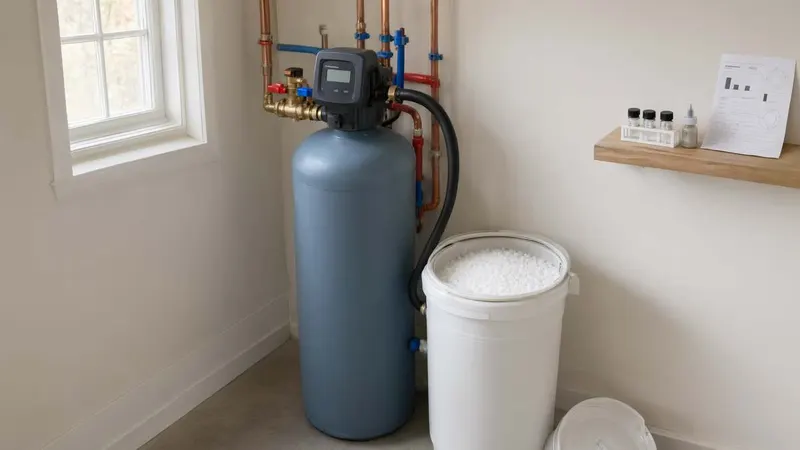
Best Water Softener Test Kits and Strips (And How to Use Them)
This guide may contain affiliate links. If you buy through them we may earn a commission at no extra cost to you. How we make money.
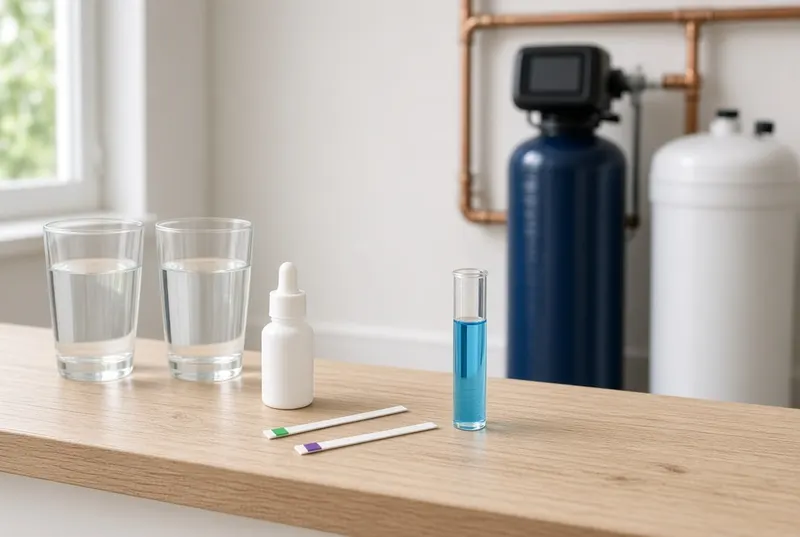
Water from a working softener should test at or near 0 grains per gallon (gpg). Test strips are fine for quick monthly checks: they tell you whether the softener is doing its job. A drop titration kit gives the exact number you need to program the softener and to track down a problem when softened water still tests hard.
This guide is for people who already have a softener. If you are new to testing, start with how to test water hardness at home; for general kits, see our water hardness test kit comparison. For sizing a new softener, use our water softener size calculator.
In this guide
How to Check If Your Water Softener Is Working
You need two tests: one before the softener and one after. Comparing them is what tells you whether it works.
- Test raw (unsoftened) water. Use an outdoor spigot, which is often plumbed before the softener, or put the softener in bypass and run a cold tap for a minute. This is your starting hardness.
- Test softened water. Return the softener to service, run a cold kitchen or bathroom tap for a minute, and test again. Use cold water, because strips are made for it.
- Compare the two results.
- 0–1 gpg after the softener: It is working.
- A few gpg after the softener: It is only partly softening. Check the causes below.
- Almost no change: Water is going around the softener, or it has stopped regenerating.
Write down both numbers and the date. A simple log makes it easy to spot a slow decline.
Our Picks
Hardness strips don't measure iron. If you have a private well, test iron separately with an iron test or a certified lab, because iron affects how a softener works (see below).
Strips vs Drop Kits for Softener Owners
| Test strips | Drop titration kit | |
|---|---|---|
| What you get | A range: soft to very hard | An exact number in gpg |
| Precision | Within about 25–50 mg/L (1.5–3 gpg) | 1 gpg (17.1 mg/L) |
| Approx. cost | $8–$15 for 50–100 tests | $15–$80 |
| Time per test | About 1 minute | About 5 minutes |
| Best use | Monthly "is it still working?" checks | Programming the softener and finding problems |
Many owners use both: strips for a quick monthly check, and a drop kit when they set up the softener or when a strip shows hardness creeping back. If you buy only one water softener test kit, make it a drop kit: it can do both jobs, while strips can't give you the exact number you need for the settings.
Signs Your Softener Has Stopped Working
Your softener may have stopped working if you notice:
- Scale coming back on faucets, showerheads and kettles
- Spots and film on glasses again (see the signs of hard water)
- Soap and shampoo lathering less than they used to
- A filmy feeling on your skin after a shower, a change some homeowners notice first
- The salt level in the brine tank not going down over several weeks, which can mean the softener isn't regenerating
Any of these is a reason to test raw and softened water and compare.
Softened Water Still Tests Hard? Common Causes
Bypass valve partly open
Most softeners have a bypass valve that lets water go around the unit during maintenance. If it was left partly open, some hard water mixes with softened water and you get a few gpg after the softener. Check the valve position against your owner's manual and make sure it is fully set to "service."
Salt bridge or salt mush in the brine tank

These are two different problems with the same result: weak brine, so the softener can't fully regenerate and hard water gets through.
- Salt bridge: a hard crust forms across the brine tank and leaves an empty gap underneath. The tank looks full, but the water below can't reach the salt. High humidity, overfilling the tank and low-purity salt make bridges more likely.
- Salt mush: a soft, sludge-like layer of salt settles at the bottom of the tank. It forms when dissolved salt recrystallizes into fine particles, often together with insoluble impurities from lower-purity salt. It can restrict how much brine the softener draws in.
To check, put the softener in bypass and gently push a broom handle into the salt. If it stops at a hard layer, you have a bridge: break it up carefully with the handle (not a sharp metal tool), remove the loose chunks, then take the softener out of bypass and run a manual regeneration as described in your owner's manual. If the salt is loose but there is a soft sludge at the bottom, that is mush: follow your manual for cleaning it out. To prevent both, keep the salt level below the top of the tank, use high-purity pellet salt and check the tank every month or two.
Hardness setting too low
The softener uses the hardness you enter to decide how often to regenerate. If the setting is lower than your real raw-water hardness, the resin runs out before the next regeneration and hard water gets through. Re-test raw water with a drop kit and enter the real number in gpg. If you have iron in your water, check your manual, because many manufacturers ask you to raise the setting to account for it.
Iron fouling or worn-out resin
Iron isn't shown on hardness strips, but it can coat the softener's resin beads and reduce how much hardness they remove. On well water, test iron separately. Resin also wears out slowly over the years. If the settings, salt and valves are all correct and softened water still tests hard, ask a water treatment professional or the manufacturer to check the resin. If you end up replacing the softener, look for one certified to NSF/ANSI 44, the standard for residential water softeners, which covers how well a unit reduces hardness.
Regeneration problems
A softener that doesn't regenerate stops removing hardness. Common causes are a clock that reset after a power cut on timer-based models, a regeneration schedule set too far apart for your water use, and a stuck or faulty control valve. Check the time and settings on the control head, then start a manual regeneration as described in your manual and re-test the next day.
Plumbing changes
After a renovation or repair, some lines may no longer run through the softener. A new bathroom, kitchen or water heater line connected before the softener will deliver hard water even when the softener works perfectly. Test at several taps: if only one area tests hard, look at the plumbing.
How Often Should You Test?
- Every month: Test softened water with a strip. It takes a minute and catches problems early.
- Every few months: Test raw and softened water with a drop kit and compare.
- Right away: After you install or reprogram the softener, after a power cut on a timer model, after you clear a salt bridge, or whenever you notice scale or spots coming back.
If you are on a private well, also follow the EPA's advice to test the well itself every year.
How we researched this guide: We based it on manufacturer specifications and instructions, university extension guidance, EPA sodium guidance and the problems softener owners report most often. We did not lab-test these kits ourselves.
Frequently Asked Questions
What should softened water read on a test strip?
It should read at or near zero, which is the softest color on most charts. A drop kit should show 0–1 gpg. If you read a few gpg or more, the softener is only partly working; check the causes above.
Can I use pool test strips for my softener?
It's not ideal. Pool "calcium hardness" strips are designed for the much higher levels kept in swimming pools, so their color steps are usually too coarse to tell 0 gpg from a few gpg. Use strips made for household water or softeners, or a drop kit.
Do softener test strips expire?
Yes. Strips have an expiry date printed on the bottle, and strips that absorb moisture can read too low. Keep the bottle tightly closed, store it in a cool, dry place and don't use strips past the date.
Why does my softened water taste salty?
An ion-exchange softener adds sodium as it removes hardness: about 8 mg/L of sodium for each grain of hardness removed, according to the Water Quality Association as cited by the University of Nebraska. Very hard water gets more sodium: at 25 gpg, that is about 200 mg/L. The EPA's drinking water advisory for sodium notes that 30–60 mg/L can affect taste for many people, and recommends no more than 20 mg/L for people on a very low sodium diet. Options include keeping one unsoftened cold tap for drinking, using potassium chloride instead of salt (it adds no sodium but usually costs more and can be harder to find), or adding an under-sink reverse osmosis filter. If you are on a sodium-restricted diet, ask your doctor.
Does a water softener remove a rotten-egg smell?
No. A rotten-egg smell comes from hydrogen sulfide, which a standard softener isn't designed to remove. It needs a different type of treatment, so test for it separately.
Sources
- U.S. EPA — Drinking Water Advisory: Sodium
- U.S. EPA — Private Drinking Water Wells
- U.S. Geological Survey — Hardness of water
- University of Nebraska–Lincoln Extension — Drinking Water: Hard Water (G1274)
- North Dakota State University Extension — Water Softening (Ion Exchange)
- NSF/ANSI 44 — Residential cation exchange water softeners
- Manufacturer manuals for residential water softeners (settings, bypass and regeneration)