How Do You Know If You Have Hard Water? 9 Signs and 3 Quick Tests
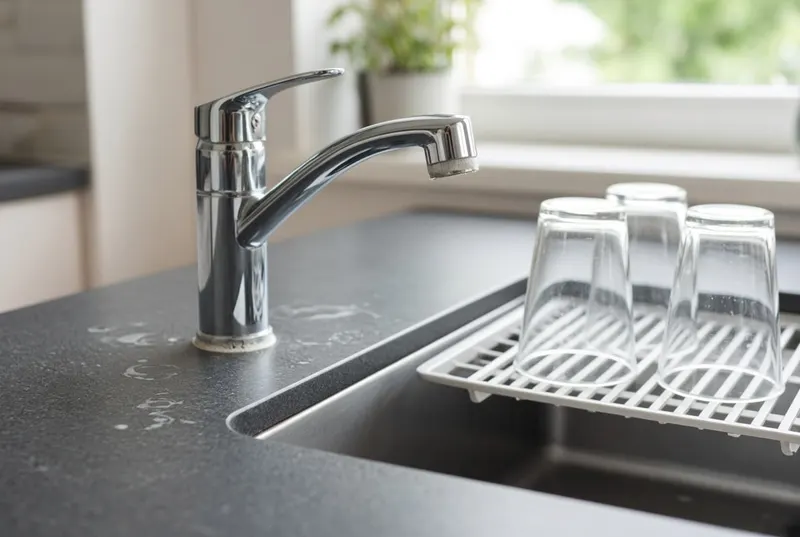
How do you know if you have hard water? The clearest signs are white, chalky scale on faucets and kettles, spots and film on glasses, and soap that barely lathers. Hard water looks perfectly clear, so you notice its effects, not the minerals. To confirm it, check your utility's water quality report or dip a test strip in a cup of tap water.
Hard water is water with a lot of dissolved calcium and magnesium. It picks up these minerals as it moves through soil and rock, and it is common across much of the United States, on city water and private wells alike. It is not a health concern, but it can be a real nuisance at home. Our hard water guide covers the basics; here is how to tell if you have it.
In this guide
9 Signs You Have Hard Water
1. White, chalky crust on faucets and showerheads
The most visible sign is a white or off-white crust where water dries: around faucet bases, on aerators, on showerheads and in the bottom of the sink. This is scale, mostly calcium carbonate left behind when hard water evaporates. It builds first where water drips or sits.
Could it be something else? Try a vinegar test. Hard-water scale fizzes and slowly dissolves in white vinegar. A deposit that doesn't react may be something else, such as dried soap or silica.
2. Spots and film on glasses and dishes
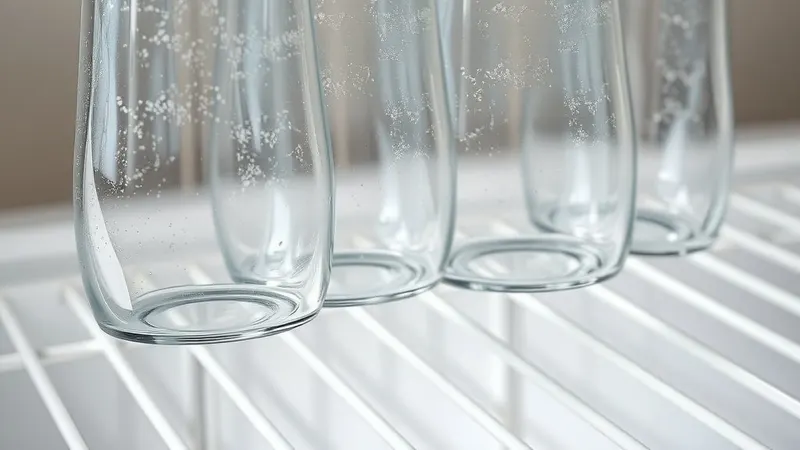
Glasses that come out of the dishwasher cloudy or covered in small white spots are a classic sign. The USGS calls this hard-water residue: "not dangerous, but unsightly."
Could it be something else? Too much detergent, or no rinse aid, can also leave a film. If a rinse aid fixes the problem, your water may only be moderately hard.
3. Soap and shampoo that don't lather well
In hard water, soap reacts with calcium and magnesium and forms soap scum instead of foam. You need more soap, shampoo and detergent to get things clean. Your hands may feel like they still have a film on them after washing, which the USGS gives as an everyday sign of hard water.
4. Soap scum on tubs, tiles and shower doors
That same reaction leaves a gray-white film on tubs, tiles and glass shower doors. It comes back quickly after cleaning and is harder to wipe off than ordinary dirt. On glass, it often mixes with scale, which is why hard-water stains on shower doors can be so stubborn.
5. Dry skin and dull, stiff hair after a shower
Many people say their skin feels dry or tight and their hair looks dull after showering in hard water. Soap scum left on skin and hair is the likely reason. It is a comfort issue, not a medical one.
Hard water is often blamed for eczema, but the evidence doesn't support using a softener as a treatment. In the Softened Water Eczema Trial, a randomised study of 336 children living in hard water areas, eczema improved by about 20% in homes with an ion-exchange softener and about 22% with usual care alone, so the softener made no measurable difference.
Could it be something else? Dry indoor air, long hot showers and many soaps and shampoos cause the same feeling. If you suspect a skin condition, talk to a doctor.
6. Stiff, dingy laundry
Hard water makes detergent less effective, so clothes and towels can come out stiff, scratchy or grayish. The USGS notes that hard water can even shorten the life of fabrics. Using a little more detergent can help, but scale and soap residue build up over time.
7. Scale inside kettles and coffee makers
Look inside your kettle or coffee maker. A white or tan crust on the bottom or around the heating element is scale. Heating hard water makes calcium carbonate come out of solution, which is why appliances that heat water show scale first. This is the reason many people run vinegar through their coffee maker.
8. Low water pressure from clogged aerators and showerheads
Scale can slowly clog faucet aerators, showerhead holes and, over many years, the inside of pipes. You may notice a weaker or uneven spray from one fixture.
Could it be something else? If the pressure is low at every tap in the house, the cause is usually not hardness. Unscrew one aerator first: if it is full of white grit, scale is likely the problem.
9. A water heater that pops, rumbles or works harder
When hard water is heated, scale forms inside the water heater. According to the USGS, it can shorten equipment life, raise the cost of heating water and lower the efficiency of electric water heaters. A popping or rumbling sound from a tank heater is often scale and sediment at the bottom. Tankless water heaters are especially sensitive to scale, which is why some installers check hardness before they install one.
3 Quick Ways to Confirm It
If you are still unsure how to tell if you have hard water, a quick test settles it. The signs tell you that your water is probably hard. A test tells you how hard, and that number is what you need to choose and set up any treatment.
Check your water quality report (free)
If you are on city water, your utility publishes an annual water quality report, called a Consumer Confidence Report. Find yours through the EPA's CCR page and look for "hardness" or "total hardness."
Try the soap test (free)
Shake a clear bottle one-third full of tap water with about 10 drops of pure liquid soap. Lasting foam and clear water suggest soft water; few bubbles and cloudy water suggest hard water. It gives no number, only a first answer.
Use a test strip
Dip a hardness test strip in a cup of cold tap water and compare the color with the chart. You get a range in about a minute. See our comparison of the best water hardness test kits.
For every method, step by step, see our guide on how to test water hardness at home.
How Hard Is "Hard"?
The USGS classifies water hardness like this. Milligrams per liter (mg/L) and parts per million (ppm) are the same number, and one grain per gallon (gpg) equals 17.1 mg/L. Our hardness converter switches between units.
| Classification (USGS) | mg/L or ppm | gpg |
|---|---|---|
| Soft | 0–60 | 0–3.5 |
| Moderately hard | 61–120 | 3.5–7 |
| Hard | 121–180 | 7–10.5 |
| Very hard | Over 180 | Over 10.5 |
Where Hard Water Is Most Common
Hardness depends on the rock your water passes through. Water picks up calcium and magnesium as it moves through limestone and similar rock, so groundwater in those areas is often hard. A USGS study of about 2,100 domestic wells found hard water most often in the east-central and western United States, where carbonate aquifers are common.
Regional maps only give you a general idea. The USGS itself notes that its national hardness maps are not designed for decisions about a single home, and that your local water utility or health agency is the right source for information about your water. So even if you live in a "soft water" region, the signs above, or a simple test, are a better guide than a map.
What to Do If You Have Hard Water
You don't always need an expensive system. Match the fix to how hard your water is and what bothers you most:
- For scale on fixtures and appliances: Clean with white vinegar and descale kettles and coffee makers regularly.
- For dishes: Use a rinse aid and a detergent made for hard water.
- For very hard water (over about 10.5 gpg): A whole-house water softener is often the practical fix, especially with a tankless water heater.
A softener has trade-offs. An ion-exchange softener adds sodium to the water as it removes hardness, it uses salt that you need to refill, and it needs regular maintenance. If you are on a low-sodium diet, ask your doctor before drinking softened water; many homes keep one unsoftened cold tap for drinking.
Frequently Asked Questions
Can you tell if water is hard just by looking at it?
No. Hard water looks clear, just like soft water. You can only see its effects, such as scale, spots and soap scum. To know for sure, check your water report or test it.
Is hard water safe to drink?
Yes. The USGS states that hardness is not a health concern, and the World Health Organization has not set a health-based guideline for hardness in drinking water. The EPA has no health-based limit for it either. Its effects are on taste, soap, plumbing and appliances.
Why do I have hard water even though I'm on city water?
Most utilities treat water to make it safe, not to soften it. Hardness depends on the source: water drawn from rivers, lakes or wells that run through limestone and similar rock picks up calcium and magnesium along the way.
Does a water softener get rid of all these signs?
A correctly sized and maintained ion-exchange softener removes the calcium and magnesium that cause scale, spots and soap scum. It won't remove existing scale overnight, and it won't fix problems caused by iron, manganese or hydrogen sulfide.
Will a whole-house water filter fix hard water?
Usually not. Most whole-house filters, such as sediment and carbon filters, don't remove calcium and magnesium. Ion-exchange softeners remove them. Salt-free "conditioners" are designed to change how scale forms, but the water still tests hard. This is one of the most common points of confusion in homeowner forums.
Why does softened water feel slippery?
That slippery feeling is normal. Soap rinses off differently in soft water because it isn't forming soap scum. It doesn't mean soap is left on your skin.
If I can see the signs, do I still need to test?
Yes, if you plan to buy treatment. The signs tell you that your water is hard; a test tells you how hard. You need that number to choose a softener and set it correctly.
Sources
- U.S. Geological Survey — Hardness of water
- U.S. EPA — Consumer Confidence Reports
- U.S. EPA — Secondary Drinking Water Standards: Guidance for Nuisance Chemicals
- Thomas et al., PLOS Medicine (2011) — A Randomised Controlled Trial of Ion-Exchange Water Softeners for the Treatment of Eczema in Children
- World Health Organization — Hardness in drinking-water
- University of Nebraska–Lincoln Extension — Drinking Water: Hard Water (G1274)