Water Softener Hardness Setting: What Number Should You Set?
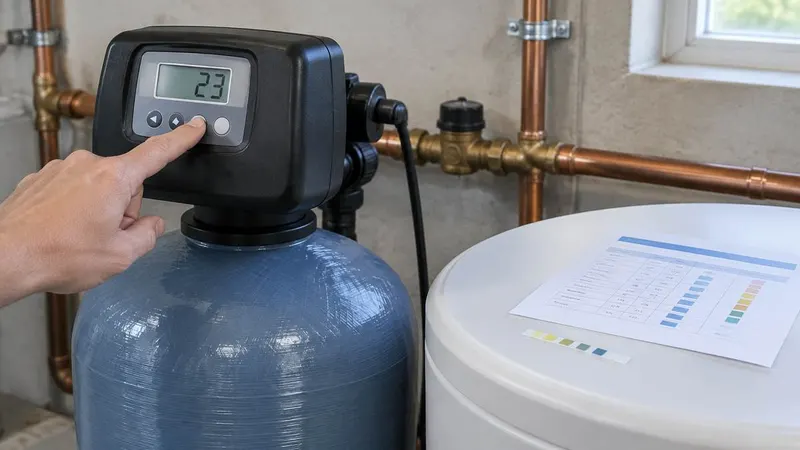
Compare with your current setting
Use the capacity your manual lists for your salt setting if it gives one. The calculator then shows roughly how many gallons the softener treats between regenerations.
Set your softener to15grains per gallon
- Your untreated water
- 15 gpg (257 mg/L)
- USGS classification
- Very hard
- Added for iron
- 0
- Gallons between regenerations
- —
Don't have a number yet? Our guide on how to test water hardness at home explains every method, and the hardness converter switches between units.
In this guide
How to Find Your Water Softener Hardness Setting
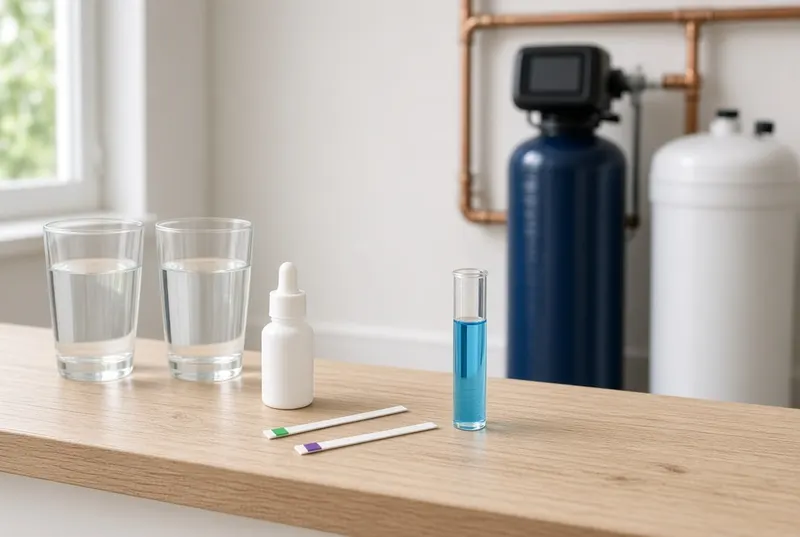
- Test the untreated water. Take the sample from a tap before the softener, such as an outdoor spigot, or put the softener in bypass. Testing softened water gives a number near zero, which is useless for programming.
- Convert to grains per gallon. Softener controls use gpg. Divide mg/L or ppm by 17.1. Example: 257 mg/L ÷ 17.1 = 15 gpg.
- Add 5 for each ppm of iron. Example: 15 gpg with 1 ppm iron becomes 20.
- Round up and enter the number. The manuals we checked give no rounding rule; rounding up is the cautious choice, because a setting that is too low lets hard water through.
- Check the result. A week or so later, test the softened water. It should read at or near 0 gpg. Our guide to water softener test strips explains how.
What the Hardness Setting Actually Does
Most modern softeners regenerate based on the water you use. The control divides the softener's capacity by your hardness setting to work out how many gallons it can treat, counts the gallons through its meter, and regenerates before the resin runs out.
That is why the setting matters:
- Set too high: the softener thinks the resin is used up sooner. It regenerates more often than needed, which uses more salt and water. The water is not any softer.
- Set too low: the softener waits too long. The resin runs out before it regenerates, and hard water gets through, usually in the last day or two of each cycle.
Example: a 32,000-grain softener set to 25 treats about 1,280 gallons between regenerations. Set to 15, the same softener treats about 2,130 gallons. If your water really is 15 gpg, the setting of 25 makes it regenerate about 1.7 times as often as it needs to.
Why Is My Water Softener Set to 25?
On many softeners, 25 is simply the factory default. The Morton M45C manual, for example, lists a default hardness of 25 gpg and tells owners to replace it with their own number. If nobody changed it at installation, your softener may be using that default. For water softer than 25 gpg, that means extra regenerations and wasted salt; for water harder than 25 gpg, it means hard water slipping through.
Water Softener Hardness Setting Chart
Settings for common test results, rounded up, using the manufacturers' rule of 5 for each ppm of iron:
| Untreated hardness (mg/L or ppm) | gpg | Setting, no iron | With 1 ppm iron | With 2 ppm iron |
|---|---|---|---|---|
| 50 | 2.9 | 3 | 8 | 13 |
| 100 | 5.8 | 6 | 11 | 16 |
| 150 | 8.8 | 9 | 14 | 19 |
| 200 | 11.7 | 12 | 17 | 22 |
| 250 | 14.6 | 15 | 20 | 25 |
| 300 | 17.5 | 18 | 23 | 28 |
| 350 | 20.5 | 21 | 26 | 31 |
| 400 | 23.4 | 24 | 29 | 34 |
| 500 | 29.2 | 30 | 35 | 40 |
Iron, Manganese and Older Softeners
Iron. The Morton, Rheem and GE manuals all use the same rule: add 5 to the hardness number for each 1 ppm of iron. Some independent guides use 4 instead. We use the manufacturers' figure.
Manganese. The manuals we checked give no separate rule for manganese. If your water has manganese, ask the softener's manufacturer how to account for it.
Older softeners. Some guides suggest adding a few grains for an older softener, because worn resin holds less hardness. A better approach is to test: if softened water starts to read hard near the end of each cycle, raise the setting by 1 or 2 and test again.
Frequently Asked Questions
What hardness should I set my water softener to?
The hardness of your untreated water in grains per gallon, plus 5 for each ppm of iron, rounded up. For water at 250 mg/L with no iron, that is 15.
Will a higher hardness setting make my water softer?
No. Softened water should already read at or near 0 gpg. A higher setting only makes the softener regenerate sooner, which uses more salt and water.
What if my water report shows ppm or mg/L?
Divide by 17.1 to get grains per gallon. Milligrams per liter and parts per million are the same number for hardness.
Why does my softened water still test hard?
Common causes are a setting lower than the real hardness, a bypass valve that is partly open, a salt bridge in the brine tank, or worn or iron-fouled resin. Our water softener test strips guide walks through each one.
Do I need to change the setting if I switch to potassium chloride?
The hardness setting describes your water, so it stays the same. Check your manual for any change to the salt dose when you switch salt types.
What size softener do I need for my hardness?
Use our water softener size calculator. It takes your hardness, household size and iron into account.
Sources
- Morton — M45C water softener manual, programming the water softener
- Rheem — RHW42 water softener manual, programming
- GE — GXMH31H water softener manual, setting hardness
- Nelsen Corporation — Softener sizing
- U.S. Geological Survey — Hardness of water