Pool Volume Calculator: How Many Gallons Is My Pool?
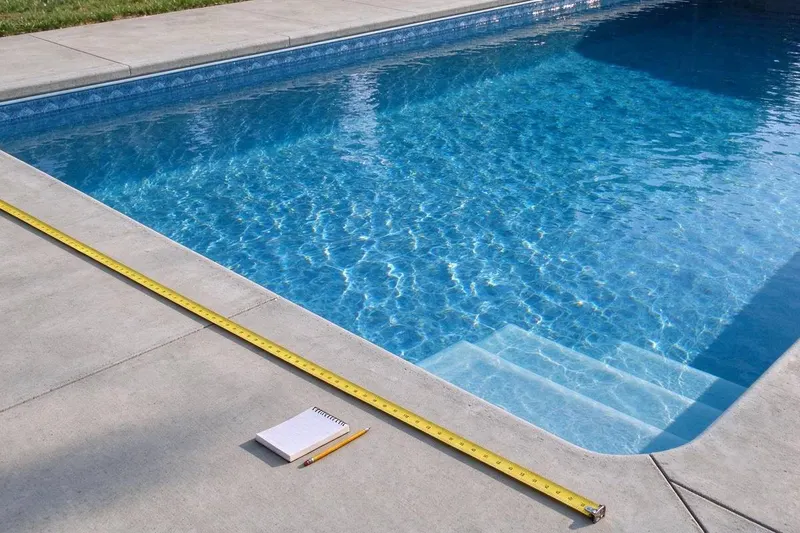
Measure depth to the water line, not to the top of the wall. For a pool with one depth (most above-ground pools), enter the same number twice.
Your pool holds about21,070 gallons79,700 liters
- Average depth
- 5.5 ft
- Surface area
- 512 sq ft
- Volume
- 2,816 cu ft
Next step for a saltwater pool: use the gallons in our pool salt calculator.
In this guide
How to Measure Your Pool
- Length and width. Measure the water surface at its longest and widest points, inside wall to inside wall.
- Depth. Measure from the water line to the floor at the shallow end and at the deep end. The average is (shallow + deep) ÷ 2. Example: (3 + 8) ÷ 2 = 5.5 ft.
- Round pools. Measure the diameter straight across through the center. The radius is half of it.
- Kidney pools. Measure the length, the widest part (A) and the narrowest part (B).
Pool Volume Formulas
All formulas give cubic feet; multiply by 7.48 to get U.S. gallons. In meters, the result is cubic meters; multiply by 1,000 to get liters.
| Shape | Surface area | Gallons (feet) |
|---|---|---|
| Rectangle or square | length × width | length × width × average depth × 7.48 |
| Round | 3.14 × radius × radius | 3.14 × radius² × average depth × 7.48 |
| Oval with straight sides | (length − width) × width + 3.14 × (width ÷ 2)² | area × average depth × 7.48 |
| Elliptical | 3.14 × (length ÷ 2) × (width ÷ 2) | area × average depth × 7.48 |
| Kidney | (A + B) × length × 0.45 | area × average depth × 7.48 |
Many pool stores round 7.48 up to 7.5, so their numbers come out about 0.3% higher. Some charts also use shortcut multipliers, such as 5.9 for round pools, which is 3.14 ÷ 4 × 7.5 applied to the diameter instead of the radius. The results are the same within rounding.
Pool Volume Chart: Common Sizes
Calculated with the formulas above at the depths shown.
| Pool | Average depth | Gallons |
|---|---|---|
| 12 ft round above-ground | 4 ft | about 3,380 |
| 15 ft round above-ground | 4 ft | about 5,290 |
| 18 ft round above-ground | 4 ft | about 7,610 |
| 24 ft round above-ground | 4.5 ft | about 15,230 |
| 15 × 30 ft oval (straight sides) | 4.5 ft | about 13,520 |
| 12 × 24 ft rectangle | 5 ft | about 10,770 |
| 16 × 32 ft rectangle | 5.5 ft | about 21,070 |
| 20 × 40 ft rectangle | 5.5 ft | about 32,910 |
Why Your Pool Volume Matters
Every chemical dose on a product label is given per gallons of water, usually per 10,000 gallons. If you overestimate the volume, you add too much; if you underestimate it, the treatment may not work. The pool volume is also what you need to size a pump, a filter, a heater or a salt chlorinator.
Frequently Asked Questions
How many gallons are in a cubic foot?
About 7.48 U.S. gallons. Many pool guides round it to 7.5.
How do I find the average depth of a sloped pool?
Add the shallow end depth and the deep end depth and divide by 2. For a pool with a long, flat deep section, this slightly underestimates the volume; measure the depth at several points and average them for a closer number.
How many gallons is a 24 ft round above-ground pool?
At a water depth of 4.5 ft, about 15,200 gallons. At 4 ft, about 13,500 gallons.
Can I find my pool volume from my water bill?
If you fill the pool from empty and nothing else uses much water that month, the meter reading before and after gives a close number. Many utilities bill in cubic feet or in units of 100 cubic feet; multiply cubic feet by 7.48 to get gallons.
Sources
- Leslie's — Calculating pool volume
- City of Akron — Pool gallons formula