Pool Salt Calculator: How Much Salt to Add to Your Pool
New pool or fresh water? Enter 0 for the current level. Don't know your gallons? Use our pool volume calculator.
Salt to add100 lb2.5 bags of 40 lb (45 kg)
- Salt to raise
- 800 ppm
- Per 1,000 gallons
- 6.7 lb
This is the amount of pure salt needed in theory. Add a little less than the full amount, let it dissolve, and test again before adding the rest.
In this guide
How the Pool Salt Calculation Works
A gallon of water weighs about 8.34 lb, and ppm means pounds of salt per million pounds of water. So:
Pounds of salt = gallons × (target ppm − current ppm) × 8.34 ÷ 1,000,000
Example: a 15,000-gallon pool at 2,400 ppm, aiming for 3,200 ppm. 15,000 × 800 × 8.34 ÷ 1,000,000 = 100 lb, or two and a half 40 lb bags.
Pool Salt Chart
Pounds of salt for common pool sizes:
| Pool size | New pool (0 to 3,200 ppm) | Raise 400 ppm | Raise 800 ppm |
|---|---|---|---|
| 5,000 gallons | 133 lb (3.3 bags) | 17 lb | 33 lb |
| 10,000 gallons | 267 lb (6.7 bags) | 33 lb | 67 lb |
| 15,000 gallons | 400 lb (10 bags) | 50 lb | 100 lb |
| 20,000 gallons | 534 lb (13.3 bags) | 67 lb | 133 lb |
| 25,000 gallons | 667 lb (16.7 bags) | 83 lb | 167 lb |
| 30,000 gallons | 801 lb (20 bags) | 100 lb | 200 lb |
Bags are 40 lb. Most of a new pool's salt goes in once; after that, you only top up what is lost through splash-out, backwashing and rain overflow. Hayward notes that salt does not evaporate or wear out.
What Salt Level Should a Saltwater Pool Have?
Follow the manual for your salt chlorinator, because ranges differ between brands and models. As an example, Hayward's AquaRite manual gives 2,700 to 3,400 ppm, with 3,200 ppm as optimal. Hayward also notes that low salt reduces chlorine output, high salt can shut the chlorinator down, and most people start to taste salt at around 3,500 to 4,000 ppm.
Which Salt to Use
Hayward's manual calls for sodium chloride that is more than 99% pure. It says not to use rock salt, salt with yellow prussiate of soda, salt with anti-caking additives, or iodized salt. Water-softener salt pellets are acceptable but dissolve more slowly. Bags sold as pool salt usually meet this standard; check the label.
How to Add Salt to a Pool
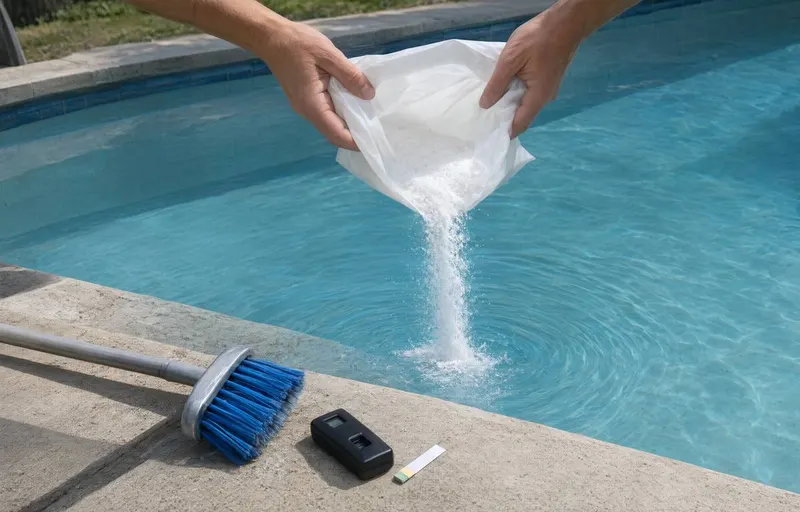
- Test first. Use salt test strips, a digital tester or your chlorinator's reading, and know your pool volume.
- Add the salt with the pump running, spreading it around the shallow end rather than dumping it in one spot.
- Brush the floor so undissolved salt does not sit in a pile.
- Circulate for 24 hours. Hayward recommends running the filter pump for 24 hours with suction from the main drain so the salt spreads evenly.
- Test again before adding more.
Salt Level Too High?
The only practical way to lower salt is to replace some of the water with fresh water. The share to replace is 1 − (target ÷ current). For example, to bring 4,000 ppm down to 3,200 ppm, replace about 20% of the water. The calculator does this for you when your current level is above the target.
Frequently Asked Questions
How many bags of salt do I need for a new pool?
For a new pool filled with fresh water and a target of 3,200 ppm, plan on about 2.7 lb of salt per 100 gallons: about 6.7 bags of 40 lb for 10,000 gallons, or 13.3 bags for 20,000 gallons.
Can I use water softener salt in my pool?
Hayward's manual allows water-conditioning salt pellets if they are pure sodium chloride, but they dissolve more slowly than pool salt. Avoid any salt with additives, iron removers or anti-caking agents.
How long does pool salt take to dissolve?
Fine pool salt dissolves within hours when brushed and circulated. Follow your chlorinator's manual: Hayward recommends 24 hours of circulation before relying on the salt reading.
What happens if I add too much salt?
Above the chlorinator's range, it may stop producing chlorine, and the water may taste salty. Lower it by draining part of the pool and refilling with fresh water.
Sources
- Hayward — How much salt do you add?
- Hayward — AquaRite salt chlorination owner's manual